
Hip Replacement Rehabilitation
HIP REPLACEMENT REHABILITATION
The Hip Has Been Replaced. Now the Goal Is to Move Confidently With It.
The important question becomes:
Does Any of This Sound Familiar?
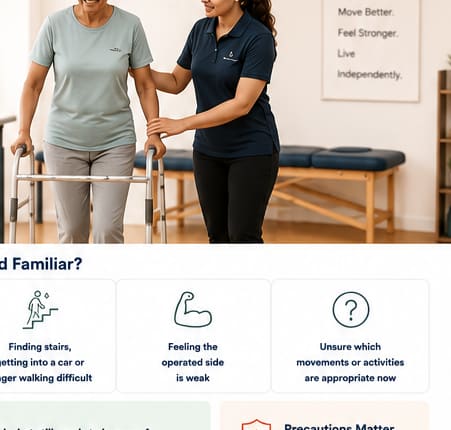
After hip replacement, you may be:
Still Using a Walker, Crutches or Walking Stick
Finding It Difficult to Get Up From a Chair or Bed
Walking Differently or Feeling Less Steady Than Before
Hip replacement surgery changes the joint.
DO NOT
Add universal hip-precaution diagrams
Add “safe / unsafe movement” graphics
Add week-by-week timelines
Add exercise illustrations
Returning to Everyday Life
Later priorities may involve stairs, longer-distance walking, driving, work, travel, exercise or recreational activity where appropriate.
Symptoms & pattern
Symptoms & pattern
Movement
Movement
Strength
Strength
Everyday function
Everyday function
Goals
Goals
Returning to Everyday Life
Later priorities may involve stairs, longer-distance walking, driving, work, travel, exercise or recreational activity where appropriate.
Assess
Understand where you are now.
Plan
Identify current priorities.
Monitor
Observe response and progress.
Adapt
Modify as needs change.
Progress
Build towards meaningful function.
HIP REPLACEMENT REHABILITATION
- ✓The Hip Has Been Replaced. Now the Goal Is to Move Confidently With It.
- ✓Hip replacement surgery changes the joint.
- ✓Recovery afterwards involves progressively rebuilding the strength, movement and physical ability needed for walking and everyday life.
- ✓Perhaps you are still using a walker, crutches or a walking stick.
- ✓Maybe getting up from a chair, climbing stairs, getting into a car or walking for longer still feels difficult.
- ✓Or perhaps you are moving reasonably well but remain cautious about what you should or should not do with the operated hip.
Sometimes Another Route May Be More Appropriate
Some Symptoms Need Prompt Medical Assessment
- Sudden severe pain with fever or feeling unwell
- Numbness in the groin or loss of bladder/bowel control
- Weakness that is rapidly worsening
- Pain after significant trauma or fall
Returning to Everyday Life
Later priorities may involve stairs, longer-distance walking, driving, work, travel, exercise or recreational activity where appropriate.
Professional Rehabilitation Should Never Feel Impersonal
Whether you are recovering from pain, surgery, neurological change or mobility limitation, you deserve rehabilitation that feels attentive, structured and responsive.
Help for a parent or family member
If you are seeking help for a parent or family member, our team provides practical guidance on clinic access, attendant involvement, records to bring and progress communication.